

WHO
WE ARE
We are a group of people who are passionate about preserving the reptiles and amphibians of Africa.
Founding Members
In 2024, fourteen herpetologists came together to provide species photos for the
Field Guide to the Snakes of Eswatini, which was the first dedicated and comprehensive book written on the 64 species found in this small southern African country.
These herpetologists established the foundation of this group, which has since grown to include thirty-one members.

Richard Boycot
Author | Herpetologist | Naturalist
From an early age, Richard has been photographing and documenting African wildlife with a particular interest in amphibians and reptiles. This interest then filtered into a variety of southern Africa’s vertebrate and invertebrate faunas. Having been involved in nature conservation in South Africa and Eswatini for over thirty years and teaching science over two decades at the United World College of Southern Africa, he has dedicated his life to nature conservation and education. Richard moved to Eswatini to take up the position of Senior Park Warden at Malolotja Nature Reserve. On arriving in the country, Richard conducted surveys throughout the country to determine what species of amphibians and reptiles occurred. These surveys revealed that Eswatini possesses a southern African microcosm of herpetofaunal diversity.
At the time of Richard’s arrival in the country, in the definitive published works by eminent herpetologists on the lizards, snakes and frogs of the region, the composition and distribution of these groups were poorly reflected. Richard embarked on a four-year research programme that terminated in the publication of his Master’s thesis, A Herpetofaunal Survey of Swaziland (1992). In this work 44 amphibians, one crocodile, five chelonians, 44 lizards and 60 snakes were recorded. For the past thirty years Richard has been studying, researching and documenting this fauna, mostly in scientific journals and also in popular books and magazines.
Richard’s photographs have appeared in virtually every regional amphibian and reptile field guide and regional red data book published over the past 35 years. He has authored or co-authored five books, including the definitive work on Southern African tortoises, terrapins and turtles (1988, 2000), the Swaziland Red Data Book (2003), Birds of Malolotja Nature Reserve (2003) and Wild Swaziland (2007). He has authored more than 100 publications, scientific papers and popular articles, on the amphibians, reptiles, fishes and birds of southern Africa.
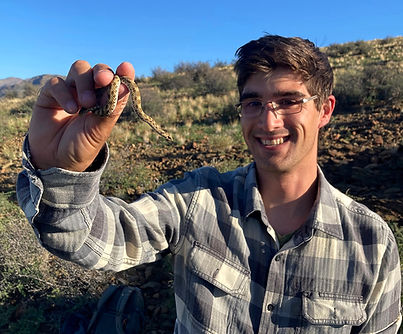
Courtney Hundermark
Author | Herpetologist | Photographer
Courtney is an avid naturalist and photographer who maintains an insatiable fascination for amphibians and reptiles. He was born in the Eastern Cape city of Port Elizabeth (Gqeberha) and currently resides in Johannesburg, Gauteng. Over the past decade, Courtney has travelled extensively in search of these creatures, exploring a number of southern African countries including Botswana, Lesotho, Namibia, his native South Africa, and Zimbabwe.
When not in the field, actively searching for amphibians and reptiles, Courtney enjoys rock climbing, free-diving, and antiquarian book collecting.
Courtney has previously obtained two tertiary qualifications in photography from Vega IIE, and recently graduated from the University of South Africa’s College of Agriculture and Environmental Sciences with a Diploma in Nature Conservation. He aims to further his studies and enrol for an Advanced Diploma (BTech) in Nature Conservation in the near future.
Professionally, Courtney has worked for the African Snakebite Institute, the South African National Biodiversity Institute’s Natural Science Collections Facility, and most recently, the South African Environmental Observation Network’s Arid Lands Node where, as a fixed-term field research assistant, he collected data for a population-level study of an endangered and endemic succulent species, the Prince Albert Vygie (Bijlia dilatata), which has since been published in the Journal of Arid Environments.
Courtney has made photographic contributions to numerous publications and field guides relating to southern African herpetofauna, and is the author of A Guide to the Reptiles of Prince Albert & the Swartberg Pass.

Miguel da Fonseca
Herpetologists | Photographer
Miguel is an aspiring herpetologist based in the South Coast of KwaZulu-Natal. His journey into photographing herps was sparked by the late Donald Strydom, whose legacy he is determined to honour.
When he's not deep in the wilderness, camera in hand, looking for reptiles to photograph, Miguel can often be found on unique rescue missions—removing snakes from unsuspecting homes. Along his journey, Miguel has encountered remarkable reptiles and has made significant contributions to local projects focused on endangered species. Yet, beyond his photographic pursuits, Miguel is motivated by a deep desire to share his passion with the world.
His ambition? To make a meaningful contribution to the herpetological community while dispelling misconceptions about snakes, one encounter at a time.

Chad Keates, PhD
Herpetologists | Evolutionary Biologist
Chad is currently employed at Hankuzi Explorations, a non-profit company dedicated to the exploration and documentation of Africa’s remote wild spaces. As General Manager, he oversees the research and operations of the NPC. Chad started his studies as a journalist at Rhodes University but quickly transitioned to Zoology in his honours, which was followed soon after by his PhD on the evolutionary structuring of African grass snakes. Since the completion of his PhD in 2021, Chad has completed two post-doctoral fellowships and has been appointed an Honorary Research Fellow at the South African Institute for Aquatic Biodiversity. Chad is an accomplished herpetologist, having authored many high-impact publications that have resulted in the discovery and description of several new taxa of both reptile and amphibian. He is a strong advocate for scientific engagement and regularly presents reptile and frog talks and demonstrations for audiences ranging from toddlers to academics. When not in the office or in the classroom, Chad is out in the field, photographing the amazing herpetological diversity that the sub-continent has to offer. In his short time as a herpetologist, he has traversed much of Southern Africa, and more recently, Angola and Zambia, with the likes of National Geographic, Okavango Wilderness Project and Hankuzi Explorations.

Kirsty Kyle
Herpetologists | Naturalist
Kirsty spent the first 25 years of her life at Kosi Bay, conducting her schooling and undergrad via correspondence. Her father was a scientist with Ezemvelo Nature Conservation and this afforded her access to amazing people, projects and places, fueling a fascination and understanding of both conservation and the natural world. Though keen on anything living and breathing, she developed a special interest in herps and did a distance-based honours degree through NWU based on amphibian acoustics, followed by a Master’s degree, also through NWU, looking at the life history of the Endangered Long-Toed Tree Frog. Upon completion of this she finally gave up on distance learning and joined UKZN for a PhD on southern African pythons which she is presently busy with. She is based in Pietermaritzburg and, though currently focusing on pythons, is still involved with projects all around Southern Africa working on anything and everything. She is married and mother to a ridiculous number of creatures.

Dylan Leonard
Herpetologists | Naturalist | Photographer
Dylan has a lifelong passion for reptiles and amphibians. For the last 14 years, he has dedicated his time and efforts to seek any and all opportunities to observe and study herpetofauna. His diverse experiences span survey work, snake rescue and relocation, education, community engagement, and managing the care and welfare of a venomous snake collection at the Dangerous Creatures Reptile House, uShaka Marine World.
As a consultant specialising in herpetofauna surveys, Dylan's expertise has been sought after for various projects. His love for travel has taken him across South Africa, allowing him to observe and document numerous species. A passionate photographer, Dylan has recorded his experiences and findings, contributing visual media to various educational resources, including numerous field guides, posters, fauna survey reports, and citizen science initiatives.
Dylan aims to promote conservation and inspire a deeper appreciation for South Africa's rich herpetofaunal diversity through his photography and consulting work.

Dave Maguire
Herpetologist | Naturalist | Field Guide
Dave has had an interest in reptiles for as long as he can remember. Growing up in Kimberley and his dad being a prospector, he was fortunate to travel South Africa extensively, always on the lookout for snakes and other reptiles.
In 2006 & 2007, he was involved with SARCA Field Surveys and started photographing reptiles
Currently, he works as a Field Guide in northern KZN and still has the opportunity to find snakes at work, and to educate those who have a phobia and misunderstand them.
"It always gives a sense of satisfaction when one is able to change a mindset and spark an interest.”

Sarah Nann
Author | Herpetologist
Sarah was born in England and moved to Africa when she was six years old. Her childhood was spent in Zambia, Malawi and Kenya, where she developed a keen interest in local wildlife, especially for snakes. She obtained an Honours degree in Zoology from Edinburgh University, during which time she was also involved in snake conservation programmes with the International Herpetological Society.
She then moved to Botswana before moving to Eswatini, where she has lived for the past thirty years.
She has been actively involved in snake rescue and relocation, and research for a Master’s degree in Psychology led to the publication of a paper about snakebite in rural communities. The requests for more information about snakes from people in these areas motivated her involvement in the publication of this field guide. Sarah is a member of The Herpetological Association of Africa (HAA).
In 2024 she was made a Paul Harris Fellow for her reptile educational work in Eswatini.

Gary Kyle Nicolau
Herpetologist | Conservationist
Gary was born in South Africa and is currently a student at Villanova University, Philadelphia, under the advisership of Dr. Aaron M. Bauer. His current studies are focused on the phylogenetics, cranial morphology, and evolution of the southern African gekkonid genus Afroedura (Flat Geckos). His main interests are in taxonomy, evolution, and conservation of African reptiles and amphibians. Gary has presented his research at both national and international conferences, has travelled extensively across southern Africa, and has an obsessive wonder for the continents’ herpetofauna.
He has a strong passion for growing the field of Herpetology in southern Africa, with ambitious goals where he will be able to work with students and researchers across various fields in the future.
Gary emphasises the importance of taking notes on natural history observations and hopes this becomes more common among the rapidly increasing number of African field-herpers. Amongst his passion in herpetology, Gary is an avid photographer, all-around naturalist, and spends whatever time he gets in the field.

Tyrone Ping
Author | Herpetologist | Naturalist | Photographer
Tyrone is a naturalist at heart with a vested interest in herpetology and photography. Growing up in Durban he always had ample opportunity to find reptiles and amphibians, so that’s exactly what he did.
This initial hobby led to a lifelong fascination, and he began his adventure through South Africa trying to locate and photograph as many of these creatures as possible.
To date, he’s photographed over 430 reptile and amphibian species in South Africa in an attempt to bring the lesser-known and seen species of reptiles and amphibians to the general public. Tyrone has one of the most comprehensive photographic libraries showcasing the intricate diversity and beauty of South African herpetuana fauna available online. His photographs can be found in countless museums, institutions, and print and digital publications, both in South Africa and worldwide, after having worked with many renowned herpetologists in Africa.
Tyrone joined Herpetological Conservation International Project Pondo in 2015 as part of the founding team. He’s been responsible for leading many exploratory missions to the habitats of the Pondo Dwarf Chameleon to confirm its localities.
He is the author of A Field Guide to Snakes & Other Reptiles of Kwazulu-Natal and A Field Guide to Snakes & Other Reptiles of the Western Cape.
Tyrone now lives in Cape Town.

John Rathbone
Herpetologist | Naturalist | Snakebite
John was born in England and joined the British Army until 1991 when he moved to Germany to train with their ambulance service as a paramedic. He later returned to England and finished his training with the Mersey Regional Ambulance Service, following which he qualified as an Emergency Care Practitioner through John Moore University in Liverpool.
In 2000, he started a personal collection of exotic venomous snakes and developed an interest in clinical toxinology.
John emigrated to Australia in 2008 to continue his career with the Queensland Ambulance Service (QAS). His keen interest in marine envenomations led him to co-author a research paper on Irukandji syndrome caused by jellyfish stings. He lectured nationally on the subject of marine envenomation, as well as on the clinical management of cases in the pre-hospital setting. John presented QAS research at two world conferences and recruited and treated snakebite patients for an antivenom trial in Papua New Guinea. During this time, he visited eSwatini several times, where he helped train medical personnel in snakebite management.
He is currently back in Queensland pursuing his healthcare career and herpetological interests.

Warren Schmidt
Herpetologist | Naturalist | Conservationist
Warren has over three decades of practical experience in ecology, conservation science, invasion biology and herpetology. He was worked as a specialist consultant, ecologist, herpetologist, journalist, magazine editor, and lecturer, and has presented talks, seminars, and lectures to thousands of people across a broad demographic spectrum, from university students and corporate entities to public interest groups. During this period, he has attended and participated in many conferences, workshops, and symposiums, including the 9th World Congress of Herpetology hosted by the University of Otago in Dunedin, New Zealand, in 2020.
He worked as Curator of Reptiles at the Transvaal Snake Park from 1 December 1992 until 28 February 1997 and then accepted a position as Farm Manager at Kwena Gardens Crocodile Sanctuary situated within the resort complex of Sun City in North West Province, South Africa.
His herpetological interests are broad but primarily focused on the diversity, taxonomy, conservation, and biogeography of snakes. However, he is also interested in the natural history of amphibians, chelonians, crocodiles and lizards. In 2019, he was awarded his Master of Science degree summa cum laude from the University of KwaZulu-Natal, South Africa.
Warren is currently engaged in various projects on African biodiversity and conservation and many of these are showcased in the newly revised website. Biodiversity & Environment Africa integrates all aspects of biodiversity into one holistic and interwoven fabric, from the smallest invertebrates to the enigmatic vertebrates and the botanical landscapes to which they depend. Africa is a continent of staggering natural beauty, culture, and home to profound biological diversity. It must be protected and cherished at all costs.

Rupert Wilkey
Author | Herpetologist | Conservationist
Rupert grew up in Kenya before moving to Malawi in 1975 and it was there that he developed a passion for reptiles and amphibians. He caught his first snake at the age of twelve and then went on to co-manage the Snake House at Blantyre Zoo for five years.
After living in Malawi for thirteen years Rupert moved to the UK, but in the early 1990s, he spent some time living in Margate on KZN's South Coast before again returning to the United Kingdom.
In 1996 Rupert was made a Founder Fellow of the Zoological Society of London and in 1998 he was made a Fellow of the Royal Geographical Society. In 2016 he took up a post at Cambridge University, winning the Student Led Teaching Award for Inclusive Practice in 2020.
In 2018, Rupert was invited by the University of Marrakech Cadi Ayyad to join a team collecting DNA samples from reptile species in the Atlas Mountains.
After almost fifty years of studying Malawi's snakes, he has become an authority on their species and has published several books on the subject. His most notable work was The Snakes of Malawi first published in 2017 and now in its 5th edition (currently being revised by Rupert and Andy Martin).
In 2022, Rupert advised the BBC’s Natural History Unit on a wildlife documentary about how evolution is forced to speed up due to human pressure and climate change in the Rift Valley, especially in reptiles.
He is a member of the Royal Society of Literature and the Society of Authors.
Rupert is now a full-time author.

Kurt van Wyk
Herpetologist | Conservationist | Photographer
Kurt has had a lifelong passion for reptiles and amphibians. Growing up in the Zimbabwean bushveld, his childhood interest in snakes rapidly snowballed to include other facets of the natural world. After completing his schooling and undergraduate studies in Europe, Kurt returned to South Africa in 2019, a move that guided him to a career in ecology.
From 2019 to 2021, he had the opportunity to work on various projects in the Fynbos Biome, including an entomological study which he completed for his Honours. He is currently pursuing a PhD through the University of the Western Cape, having spent the past three summers surveying reptiles in the lowveld of south-eastern Zimbabwe, assessing their response to habitat transformation at different spatial scales. Now settled in the Western Cape again, Kurt is eager to deepen his knowledge of African herpetofauna and share his passion with others. He has a particular interest in the ecology of secretive and endemic species, advocating for those which are often overlooked.
Members

Gus Benson
Herpetologist | Photographer
Gus born and raised in KwaZulu-Natal, is a naturalist and photographer, passionate about reptiles & amphibians. What began as a childhood curiosity has developed into a full-blown obsession, spending most of his teens searching for and photographing reptiles across his home province, slowly developing his skills and knowledge as a herper and photographer, building up a collection of images that showcases the herpetofaunal diversity across Southern Africa.

Tim Brammer
Herpetologist | Author | Photographer
Tim has a lifelong passion for reptiles. Although he was born in South Africa, he spent the majority of his formative years living in Malawi. It was here, after meeting Gary Brown, that his interest in reptiles flourished. After a brief spell at university studying Architecture, he quickly realised his mistake and moved back to Malawi to follow his passion. During the time that followed he spent the majority of his time working on various educational materials for the people of Malawi. He understood that although Reptiles and Amphibians are probably the most fascinating animals on this planet, most people are afraid of them. This age-old fear has clouded these animal in superstition, resulting in loss of life, both for the animals as well as for people. By teaching awareness courses and authoring posters, booklets and an upcoming book in the local language, Chichewa, Tim hopes to convince the younger generation that the animals he is so passionate about are interesting and worth keeping alive. Tim now works as an instructor for the African Snakebite Institute in South Africa where he focuses his efforts on expanding the institutes reach into the rest of Africa.
Due to his passion and need for images for his educational materials Tim has also dedicated an enormous amount of time to herpetological exploration and photography. He has published various range extensions for species in Malawi as well as participated in herpetological surveys for the Malawi University of Science and Technology. Most recently he was invited by Dr. Julian Bayliss and the consulting company 4Forests to join two expeditions to the Inselbergs of Mozambique. For two months they explored the Inselbergs, collecting population data on Rhampholeon bruessoworum and Rhampholeon maspictus as well as logging hundreds of records for the region. The groups explorations of Mt. Mabu can be viewed on the BBC’s website.

Gary Brown
Herpetologist | Author | Photographer
Born in the UK, Gary moved to Africa in 1974, first to Zambia, then to Malawi. Educated in South Africa, matriculating in 1985.
For over 40 years, he has been collecting and studying snakes and other local fauna, documenting and photographing species and locations.
Having worked as a safari guide, reptiles always held a special focus.
In 2017, he started Snakes & Creep Crawlies of Malawi, a Facebook page, to help educate people about Malawi’s snakes and other creatures.
During the next few years, he held several displays at a local farmers' market, which proved very popular with the kids, and many Malawians were keen to see the snakes that were being handled and learn more about them.
In 2019, he produced a photographic field guide, Reptiles of Malawi, with input from Rupert Wilkey. A full-colour book with over 300 pages, covering all of Malawi’s 145 species of reptiles, Snakes, Chameleons, Lizards, Tortoises & Terrapins.
His photographs can also be found in numerous Reptile books, Virtual Museums and Reptile databases.
He now lives in France, photographing the local flora and fauna there.
Publications:
• Reptiles of Malawi - 2019

Bobby Bok
Herpetologist | Author | Photographer
Bobby is a biology teacher from the Netherlands with a passion for amphibians and reptiles. Ever since early childhood, he’s fascinated (or obsessed?) by these wonderful animals. His main interest lies in the herpetofauna of Africa and the Western Palearctic, although his wife's passion for neotropical salamanders also leads him to Central America. He’s searched the deserts of Iran to see species such as Spider-tailed Viper (Pseudocerastes urarachnoides), observed Hula Painted Frogs (Latonia nigriventer) in Israel, Rhinoceros Viper (Bitis nasicornis) in the jungles of Uganda and huge Meller's Chameleons (Trioceros melleri) in Malawi and Tanzania. He also leads groups of students throughout the Mediterranean. As a biology teacher, he hopes to pass on some of his enthusiasm, knowledge and passion to the next precious generation.
Within Europe, Bobby undertook the challenge to see all the species living on the continent, which was achieved by seeing the final species on his list – the Pori Wall Lizard (Podarcis levendis) on the remote Greek islet of Pori.
Publications
-
Field Guide to the Amphibians and Reptiles of Britain and Europe.

Laura Bok
Herpetologist | Psychologist | Neuroscientist
A psychologist and neuroscientist by training, Laura is a herpetologist at heart. Based in Munich, she spends every free minute searching and photographing reptiles and amphibians in their natural habitats- whether it's Fire Salamanders and European Adders close to home, or chameleons and Puff Adders while travelling abroad. Her main passion lies in the herpetofauna of Central America, particularly Neotropical salamanders. However, she has also had the chance to explore several regions of (mainly Eastern) Africa, including Tanzania, Uganda, Morocco, and the Seychelles. Currently, she is excited about upcoming trips to South Africa, Lesotho, Kenya, Malawi, and Madagascar. She publishes her photos on her Flickr-account and Bobby´s website. Her academic work - primarily in the field of pain, with the occasional herpetological paper - can be found on ResearchGate.
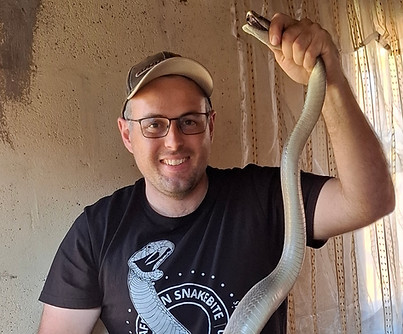
Nick Evans
Herpetologist | Conservationist
Nick is a Durban-based snake conservationist.
In 2015, he started working for himself full-time, initially focusing on reptile rescues in the Greater Durban Area. From there, he overcame his fear of public speaking, and started snake awareness talks. He has since educated thousands of people of all ages.
In 2016, Nick started his first research project, on Black Mambas. His love for research grew. He is still busy with his work on Black Mambas, but runs more projects as well, on Southern African Pythons, Green Mambas, Nile Monitor Lizards and other topics such as human/snake conflict, heavy metals in snakes etc. He has been a co-author on four scientific papers so far, with many more to go.
Nick has been the host of a T.V series called Snake Season, based on his work, which has currently run for three seasons.
He was awarded the Stevenson Hamilton Award by the Zoological Society, for his contributions towards conservation, in 2019.
Nowadays, Nick still spends his time doing reptile rescues, research & education. He is also a specialist consultant for EIA companies, is trying to tackle the illegal wildlife trade, and is working on at least one book.
Nick does not only have an interest in herpetofauna, but all wildlife, and aids in research projects on other animals, such as Crowned Eagles.

Florian Finke
Herpetologist | Photographer
Florian was born and raised in Germany, but travelled to Kenya in 1986 with his parents.
He has been interested in dinosaurs and crocodiles since early childhood, and caught his first chameleon in Nairobi at the age of 10 in 1996.
In 2000, he kept the first non-venomous snakes, then a year later, at the age of 15, he moved into venomous snake species.
Florian has now specialised in East African herpetology, especially snakes of Kenya, since 2014.
He is also an ER nurse with a main interest in cardiology and snake venoms - concentrating on venomous snakes, their toxins, first aid and treatment.

Daniel Liepack
Herpetologist | Photographer
Daniel has been deeply involved with reptiles since the age of 12, with a specific focus on venomous snakes beginning at the age of 16. With over two decades of experience in herpetology, he primarily concentrates on the photography of venomous snakes.
Since 2012, he has travelled to countries such as Kenya, Tanzania, India, Thailand, and Australia, aiming to locate and document all kinds of reptile species in their natural habitats.

Berkeley Lumb
Herpetologist | Photographer
Berkeley has always had a fascination with animals.
Growing up on a farm in South Africa’s Klein Karoo region, he has always been surrounded by wildlife, which, from a young age, sparked an interest in herpetology and photography. As his passion for herpetology grew, he started to travel in an effort to find and document South Africa’s amazing reptile and amphibian biodiversity. Over the years, he has contributed his images to multiple books and continues to hone his photography and pursue his passion for herpetology.

Andy Martin
Herpetologist | Author | Conservationist
Andy has been involved in herpetology for the past sixty-plus years and has a deep passion and interest in practical ecology, conservation and biogeography. He was raised in Malawi, south-eastern Africa, where he observed, collected, recorded, bred and released many species of reptile and amphibian over an eight-year period. Intensive field study was also undertaken in West Africa, Borneo, Indonesia and parts of SE Asia.
Business took him to Scotland in 1986, where his study became focused on programmes for captive breeding and education based on notes and observations in the field.
Andy set up fourteen breeding groups of Pythonid species, including P. natalensis and achieved the first captive breeding in the UK of M. reticulatus (Reticulated python) in 1989.
British Herpetological Society past Scottish Group Chairman, Council member. Involved
with captive breeding, education and recording local herpetofauna.
He delivered talks, lectures and workshops to schools, universities, herpetological societies and interest groups of all ages on reptiles and amphibians – their captive breeding, ecology and conservation.
These included: Banchory Academy, Aberdeenshire – annual, year three biology workshop on reptiles, their biology, ecology and conservation. Aberdeen Science and Technology Festival (Techfest) - annual, Schools week-long programme with two-weekend family workshops. Lanarkshire Council Environmental Health Department – Annual one-day workshop for pet shop managers/owners, environmental health officers, vets and herpetologists on the care of Reptiles and Amphibians, including legislation and health.
In September 1999, he was part of a 10-person international team carrying out an ecological survey of the south-eastern quadrant of Nyika Plateau, northern Malawi.
Currently, research interests include:
M. reticulatus – resolution of the geographic distribution of the naturally occurring genetic variation in M. reticulatus. This requires a morphological and molecular (total evidence) approach and would contribute significantly to creating a system for future species management and regional management plans for skin trade quota control.
Andy is currently working on publishing observed data for M. reticulatus gathered in Indonesia. Also, the publication of herpetological data, notes and field observations from archive files on Python regius, notes on Malawi species and Sarawak species where relevant, useful and appropriate.

Bernhard Schuster
Herpetologist | Naturalist | Photographer
Interested in nature from childhood, Bernhard’s interests began with a focus on amphibians and reptiles in his native Germany. He then specialised in turtles and tortoises, which he kept and bred in captivity. He also travelled to Mexico and Central America, always looking for turtles, any other creatures and bromeliad plants.
He spent seven years in Malawi as a technical advisor, but aside from his profession, he undertook numerous trips around his home in Zomba, visiting the national parks, the bigger lakes and Mulanje Mountain. Events with the NFPS (today: Wildlife and Environmental Society of Malawi) were predominantly bird-watching trips, but he also took part in annual events like game counts in Lengwe NP and looking for frogs in the Chilwa plain.
Besides animals, his interest in plants extended to local succulents and orchids in Malawi.
After leaving Malawi, he moved to Asia and Australia, where both the wildlife and landscapes left a lasting impression.
Bernhard is a keen photographer, amassing a large collection of 35mm slides, many of which have now been converted to digital format.
website: https://claudius16.jimdofree.com/
Memberships:
Wildlife Society of Malawi (1985-1992)
Mulanje Mountain Club (1985-1992)
German Herpetological Society (since 1974)
German Bromeliad Society DBG (since 2007)
Zimbabwe Orchid Society (1986-1992)

Ruan Stander
Herpetologist | Author | Photographer
Ruan has been interested in reptiles and amphibians since early childhood. He grew up in South Africa, where he has spent most of his life in the Limpopo Province and currently resides in KwaZulu-Natal.
He has 16 years’ experience working with wild reptiles and has conducted herpetofauna surveys in Ethiopia, the United Arab Emirates (UAE), South Africa, Lesotho and Tanzania. Ruan serves on the expert identification panel of the Biodiversity and Development Institute (BDI) and the FitzPatrick Institute of African Ornithology ReptileMAP project. Since 2015, he has diligently studied the reptiles of the Limpopo Province and Kruger National Park – the subject of his first book. His second book, Blouberg Nature Reserve: A Visitor's Guide was co-authored with Jeff W. Morris.
Stander has been writing and publishing since 2016. He has contributed numerous articles (both popular and scientific) as well as a variety of scientific short communications. He is an avid photographer and his images have been featured in publications such as A Complete Guide to the Snakes of Southern Africa, Snakes of Malawi and Conservation status of the reptiles of South Africa, Eswatini and Lesotho.
Ruan also has several years of experience in the tourism and field guiding industry, as well as research and administration in the tertiary education sector.

Washington Wachira
Herpetologist | Photographer
Born and raised in Central Kenya, Washington has been leading Wildlife Safaris and Tours in Kenya, Tanzania, Uganda and Rwanda for over a decade. He is famously known for his birding knowledge, but his skills extend into other taxa, such as mammals, insects, reptiles and amphibians. He founded Kenya Herpetology Tours (https://kenyaherpetologytours.com), a safari company offering herping safaris across Kenya. He is a member of the Kenya Professional Safari Guides Association (KPSGA).
His educational background is in Environmental Science (BSc. - studying the feeding ecology of sunbirds), Animal Ecology (MSc. - studying the urban ecology of raptors in Nairobi) and Animal Ecology (PhD.. - studying the biogeography of reptiles in Kenya). Washington has continued to enrich his knowledge through many trainings, including the Certificate course on the Biology of Amphibians and Reptiles. He co-authored the Guidebook to the Birds of Dakatcha Woodland IBA, Checklist to the Reptiles of Kenya, Checklist to the Amphibians of Kenya and the Checklist to the Birds of Eburu Forest. He is a National Geographic Explorer, on his work with African Crowned Eagles. He is also an experienced nature photographer and film-maker. He is a former Chairperson of the Kenya Herpetofauna Working Group. He is also a TED Speaker, and gave a TED Talk titled “For the love of birds” in 2017. He is a Research Affiliate at the Herpetology Section of the National Museums of Kenya. When not leading tours and safaris, he conducts research projects on the reptiles and amphibians of Kenya. Washington has also discovered a lizard species new to Science (year 2021), which was named after his second name (Agama wachirai).

Dr John Wilson
Herpetologist | Ornithologist | Naturalist
John grew up in Uganda where he became interested in wildlife, especially butterflies and birds, but also snakes, which included looking after a large Gaboon Viper.
In 1973 John moved to Malawi as a Fisheries Officer and he was posted on the southern shore of Lake Malawi where he had the opportunity to find and catch a number of species of snakes, memorably including several large Southern African Rock Pythons and a Black Mamba.
In 1987 John moved to Zomba where he spent the next 30 years. His garden was inhabited by Eastern Forest Cobras, Eastern Green Mambas, Oates’ Vine Snakes and East African Egg-eaters, amongst others.
John now lives in southern Japan where he only very occasionally encounters a snake, but it is still exciting.
Publications:
John has written over twenty -seven books, pares and articles on birds, butterflies, fish, and snakes.
Honorary Lifetime Members

Dr Shiela Broadley
Herpetologist
Shiela Broadley currently works at the Natural History Museum of Zimbabwe as an Assistant Curator of Herpetology.
Her main interest is understanding the ecology of lizards and how they can be conserved, especially those of fossorial lizards that include the reproduction which is still unknown for some species. She has written and coauthored a number of publications.
In the last three years (2021-2023) Shiela has managed to secure grants to publish checklists and occurrence data on the Global Biodiversity Information Facility (GBIF) for the Zimbabwean reptiles and amphibians.
At present, she is in the process of writing up a Field Guide of Zimbabwe Lizards.
Publications:
-
Broadley, D.G. & Broadley, S. 1996. Geographical Distribution: Serpentes: Typhlopidae: Rhinotyphlops pallidus (Cope). African Herp News 25: 45.
-
Broadley, D.G. & Broadley, S. 1997. A revision of the African genus Zygaspis Cope (Reptilia: Amphisbaenia). Syntarsus, 4: 1-23.
-
Broadley, D.G. , Chidavaenzi, R.L., Rasmussen, G.S.A. & Broadley, S. 1998. The Herpetology of the Dande Communal Lands, Guruve District, Zimbabwe.
-
Broadley, D.G. & Broadley, S. 1999. A review of the African Worm Snakes from south of Latitude 12dg S (Serpentes: Leptotyphlopidae). Syntarsus, 5: 1-36.
-
Broadley, D.G.† & Broadley, S. 2017. Contribution to the study of African Herpetology: Bibliography, and the genera and species described by Dr Donald George Broadley. Syntarsus, 7: 1-26.
-
Broadley, S. 2017. AGAMIDAE: Agama kirkii (Boulenger 1885) Kirk’s Rock Agama Sand-bathing. African Herp News 35-36.
-
Broadley, S. (in print) Preliminary Checklist of the Herpetofauna of Khami Heritage Site.
-
Mafuwe K, Broadley S, Sithole N and Dhliwayo K. 2018. Freshwater Biodiversity of the Eastern Highlands of Zimbabwe: Assessing conservation priorities using primary species occurrence data v1.4. Natural History Museum of Zimbabwe. Dataset/Checklist.
-
Mafuwe, K. Broadley, S. and Moyo, S. 2022. Use of maximum entropy (Maxent) niche modelling to predict the occurrence of Threatened freshwater species in a biodiversity hotspot of Zimbabwe. African Journal of Ecology Volume 60 Issue 3. 557-565.
"Shiela and her late husband Don have made an enormous contribution to our understanding of herpetology in Africa; so it gives us enormous pleasure to award Shiela with an Honorary Lifetime Membership.”

Sean Bush, M.D., F.A.C.E.P
Bite and sting venom specialist
Dr Sean P. Bush is an emergency physician who studies venomous bites and stings. His work was the subject of the 11-part television series, Venom ER, aired by Animal Planet:
https://www.youtube.com/channel/UCxbVAXt-3eRVU35aicgSQvg
Dr. Bush received a certificate of appreciation from the White House Medical Unit. Presently, he lives in North Carolina with his son Jude, daughter Camille. He works at UNC Lenoir Health Care and on Teladoc. When he is not working, he likes to be with his kids as much as he can.
"We have made Dr Bush an Honorary Lifetime Member in recognition of his sustained contributions to the treatment of venomous bites and stings.”

Choti Singh
Herpetologist | Director of Mfuwe Snakebite Prevention in Zambia.
Choti grew up in rural Zambia. Her fascination with snakes (and frogs), combined with compassion for all animal life, flourished in the wilds where she roamed when not compelled to be at school. With early exposure, encouragement, and access, this curiosity was fuelled into an enduring passion to not just observe, but also to conserve.
Choti studied Zoology and Animal Behaviour at universities in the USA and Canada, worked at science laboratories studying feeding behaviours in primates and snakes at the State University of New York, and has been active on the board of directors with Save The Snakes and SAVE THE FROGS! - both non-profits based in the USA.
The indelible impression of her childhood homeland beckoned, and she returned to live in Zambia. With start-up funding from SaveThe Snakes, she developed the Mfuwe Snakebite Prevention project in a rural district, raising awareness and promoting the conservation of snakes, while mitigating human-snake conflict to decrease snakebite.
Choti is a trained venomous snake handler with over 50 years of experience. She endeavours to conserve indigenous snake populations to preserve biodiversity while keeping the rural human community safe.
"We are delighted to award Choti with an Honorary Lifetime Membership for her contribution to snake conservation and promoting awareness in rural communities in Zambia. Her work over the last 50 years has not only saved human lives but also the lives of snake species.”

Stephen Spawls
Herpetologist | Author | Lecturer
Stephen went to Kenya when he was four and caught his first chameleon at the age of six. African herpetology is his main interest and he has spent 39 years on the continent. He lectures in science at City College, Norwich, England, and travels to Africa whenever he can.
Publications:
-
‘The Dangerous Snakes of Africa
-
Kenya, A Natural History
-
Field Guide to East African Reptiles.
-
Handbook of Amphibians and Reptiles of North-east Africa.
"One cannot talk about African reptiles without mentioning Steve. He is a legend and an inspiration to all of us. We owe him a huge debt of gratitude for his decades of work on the subject. We are delighted to award Steve with an Honorary Lifetime Membership in recognition of his outstanding contribution to African herpetology.”
In Memory
Throughout the years, we have bid farewell to several esteemed herpetologists. We express our heartfelt appreciation for their remarkable contributions to the field of herpetology.
Constantine John Philip Ionides
17 Jan 1901 - 22 Sept 1968
One of the great herpetologists of his generation.
Dr M. McBride Stewart
6 Feb 1927 – 2 Aug 2006.
Margaret, known to her friends as "Meg", was an American herpetologist, known for her research on the amphibians of Malawi, the Caribbean, and the United States.
Tony Edision Phelps
28 June 1941 - 5 November 2021
Tony was best known for Poole Aquarium and Serpentarium in Dorset, England.
“It is also important to encourage young herpetologists, be they professional or
amateur. I have never been empirical about my work; there is no point of gaining
experience if you do not pass it on to the herpetologists of tomorrow.”
R. C. H. Sweeney
Charles was the leading authority on Malawian snakes up until his death.
Dr Donald G. Broadley
1932 - 2016
Don Broadley is still regarded as the “Godfather” of modern herpetology.
He described as new to science 115 species and subspecies, and 8 genera and subgenera of reptiles.
Donald Strydom
? - 27 Mar 2022
Donald started the Swadini Reptile Park, which then became the Kinyonga Reptile Centre.
He was both a herpetologist and a conservationist and was probably one of the nicest men you could meet, always happy to take the time to talk.
C. R. S. Pitman
? - 1975
Charles Pitman is remembered for his work on the snakes of Uganda and Kenya.
Dr William R. Branch
12 May 1946 – 14 Oct 2018
Dr Bill Branch was a British/South African herpetologist.
For almost 40 years, he conducted field work in about 20 African countries, and several new species were named after him.